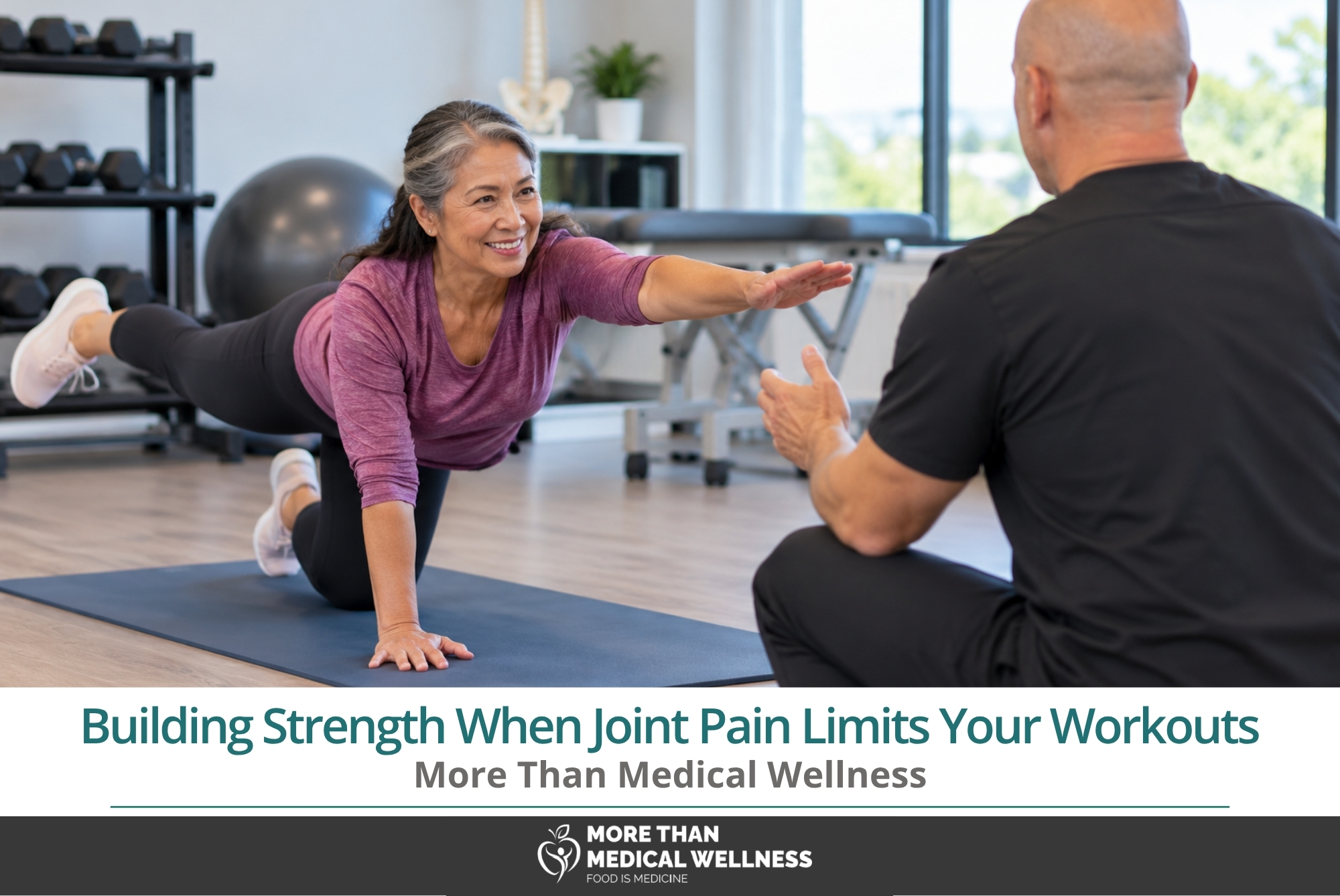
There is a problem nobody solves well: the muscle around a painful joint needs to get stronger, and the usual way to strengthen it makes the joint hurt.
Squats are the standard answer for weak quads. Overhead work is the standard answer for a weak shoulder. If those are the movements that hurt, you are stuck between losing strength and aggravating the problem, and most people end up doing less of both.
Here is what that costs you and what the alternatives look like.
Why the muscle matters more than people think
Muscle is not only for lifting things. The muscles around a joint absorb force that would otherwise go through cartilage and bone. When the quadriceps weaken, the knee takes more load directly. When the rotator cuff and scapular muscles weaken, the shoulder loses its centered position and the structures inside get pinched more often.
This is why two people with similar imaging can have completely different pain. Wear on a scan does not determine how much it hurts. How well the joint is supported has a lot to do with it.
The cycle
Pain leads to less use. Less use leads to weaker muscle. Weaker muscle leads to more load on the joint. More load leads to more pain. Nothing in that loop breaks on its own, and time usually makes it worse.
The loop breaks at the muscle. It is the only part you can change without changing the joint.
Options when loading the joint is the problem
Isometric work. Contracting a muscle without moving the joint through its range builds strength and often reduces pain in the process. A wall sit at a comfortable angle loads the quad without the range of motion that hurts.
Working around the painful range. Most joints have a range that feels fine and a range that does not. A well-designed program lives in the first one and expands it slowly.
Strengthening what is upstream and downstream. Hip and core strength changes how force reaches the knee. Mid-back and scapular strength changes how the shoulder sits. Sometimes the best thing you can do for a joint is train something else.
Electromagnetic muscle stimulation. Emsculpt NEO produces strong muscle contractions without you loading the joint at all. For someone whose knee or shoulder limits what they can do in the gym, it builds strength in the exact muscles that protect the joint while the joint itself stays out of it. At More Than Medical Wellness we use it this way, as part of a plan rather than on its own.
What this is not
It is not a replacement for movement. If you can walk, walk. If you can do modified strength work, do it. Stimulation supplements what you can do, it does not replace being active.
It is also not a fix for the joint itself. If there is significant degeneration or an unstable joint, stronger muscle helps but does not resolve the underlying problem. That is why we evaluate the joint and the muscle together rather than treating one and ignoring the other.
How this fits into a plan
For most patients with joint pain, the plan has three parts: address what is happening in the joint, rebuild the support around it, and reduce the systemic inflammation making everything more sensitive. Do one and you get partial results. Do all three and they compound.
Our regenerative medicine page covers the first part, Emsculpt NEO covers the second, and functional medicine covers the third.
If you have been avoiding the gym because of a joint, that is worth a conversation. Call (702) 465-7471 or book a consultation.